
Spring-heeled Jack, or the Victorian Batman
Following the ghost stories you read last month, today we are going to tell you about a fearsome figure from Victorian England. He was such a distinctive character—and became so deeply embedded in English culture—that he eventually evolved from a villain into a hero. The stories about him helped pave the way for modern comic books, while his image laid the groundwork for the archetype of the caped, masked superhero protecting the city from crime.
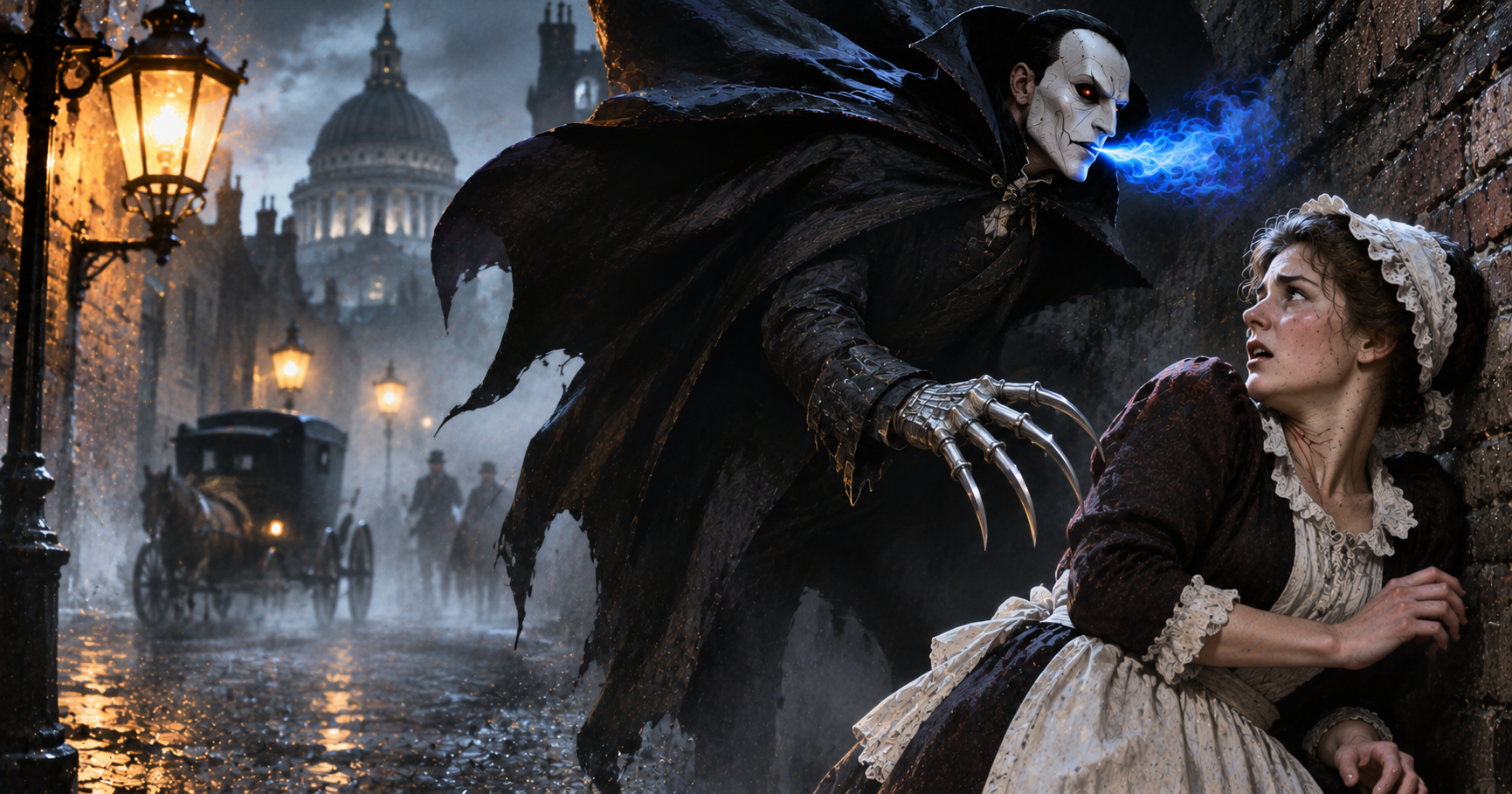
However, from the very beginning, Spring-heeled Jack committed truly malevolent deeds. He was first mentioned in October 1837. A young maid named Mary Stevens was walking toward Lavender Hill when a tall figure ambushed her from a dark alley, grabbed her—immobilising her—and began tearing at her clothes with what she would later describe as cold, metal claws. The girl’s screams chased the attacker away, but the bystanders who had gathered were unable to find any trace of him. Shortly thereafter, a similar figure jumped out in front of a moving carriage in the same area, causing the coachman to lose control and crash badly. According to witnesses, the figure escaped by jumping over a 2.7-meter wall in a single leap, all while laughing in a piercing, ringing tone. By January of the following year, the Lord Mayor of London, Sir John Cowan, began receiving complaints from terrified citizens about an unidentified villain disguised as a devil, a bear, or a ghost, frightening people so severely that two of his victims, both young girls, never fully recovered, becoming a burden to their families. Rumours depicted a tall, noble figure in disguise, wearing a tight white mask, jumping from heights that would surely have gravely injured an ordinary person. One of his victims, Ms. Jane Alsop, recounted being lured into the street by a man wearing a large cloak, who began spewing blue flames; his eyes were as red as fire. He wore a tight outfit beneath the cloak, and had iron claws on his hands. He managed to slash her neck and arms with these claws as she fled. Approximately ten days later, a similar figure attacked another young woman, Ms. Lucy Scales, blowing blue flames into her face. Terrified, she suffered a seizure, and the villain fled.
No one imagined that this villain would become a lasting urban legend, evoking fear well into the early 20th century. Some suspected he was the Devil, while others believed he was an Irish nobleman—infamous for his drunken escapades—known as the “Mad Marquess of Waterford.” Over time, tales of Spring-heeled Jack found their way into the Victorian penny dreadful and later into other media; in the process, he was transformed from a villain into a hero credited with noble deeds. A similar story emerged in the Czech lands during the 1930s and 1940s, though their character was known as Perak—the “Spring-man” of Prague.
In the 1870s, the police received further reports of encounters with Spring-Heeled Jack across various locations, including Peckham, Sheffield, and Colchester; a common thread in those accounts was that attempts to shoot at him proved ineffective. Reports of encounters with a ghostly figure in Liverpool—immediately identified as the familiar “character” due to mass hysteria—continued to emerge as late as 1904.
To this day, no one knows whether it involved a single individual, a group of villains, a succession of copycats over the years, or something supernatural. Some even link it to the “Satan’s Footprints” phenomenon, which we explored in another article. Keep reading, and don’t forget to check out the English version of our website to expand your vocabulary!
Author: Iveta Radeva

You may also like

The Ghosts of the Tower of London

The History of Puzzles from the 18th Century to the Present Day
